Sunday, March 18, 2012
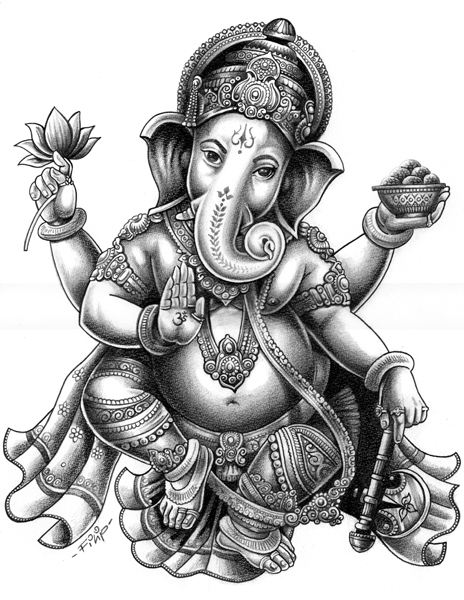
Ganesh: Guardian of the Temple
Om Gam Ganapataye Namah
This is the chant to Ganesh, the mythical figure in Hindu iconography who represents the remover of obstacles, the gatekeeper between the earthly world and the spiritual world.
Here is one version of his story.
According the Hindu mythos, Siva and Shakti represent the primordial male and female entities of the universe, the creator and mother of the universe. They are represented by the familiar eastern symbol, the yin and yang. In this symbol, the dark side represents the female aspect of the universe (not necessarily gender), embodiment, cool, dark, and movement. The light side represents the male aspect, energy, spirit, warmth, and awareness.
Early in the history of this myth, Siva was often away from Shakti as he attended to the responsibilities of ruling the universe. As happens with all newlyweds, eventually the honeymoon period seemed to be over between the two of them. Often, Siva would return home from his responsibilities of creating the universe and without much sensitivity, he felt entitled to Shakti's bed chamber. Shiva only craved the physical and Shakti craved the spirit.
Once again when Siva left, Shakti mourned the lack of intimacy that they once shared. So, from her laughter, Shakti created a son and named him Ganesh. As the son of embodied movement, Ganesh was an amazing physical creature. In addition to giving Shakti companionship and love, Shakti gave Ganesh the charge of guarding the gates to her bedroom; under no circumstances was he to allow anyone to pass.
As you may imagine, when Siva returned home, as per his habit, he marched straight toward Shakti's bed chamber and was met abruptly by this new creature, Ganesh. "None shall pass," said Ganesh (I'm thinking of Monty Python, here). Annoyed, Siva sent some of the members of his posse to go and take care of this little boy blocking the way. As the son of Shakti, Ganesh proved to be a powerful creature and probably looked like the young Vin Diesel of Hindu Gods as he cleaned house with Siva's brute force. As Ganesh was more than holding his own against his attackers, Siva started to get a little nervous. He thought, "This won't look good if this little kid takes care of my posse. Even worse if he then schools me," Siva thought. So while Ganesh wasn't looking Siva threw his trident and beheaded Ganesh.
Hearing all the commotion, Shakti came out of her room and saw her now dead son on the floor. She threw the stink-eye at Siva as if to say, "Fix this. NOW." Siva, seeing that he was in hot water, told his right hand man to go and find him a head. Any head. He returned with a head-an elephant head. Siva said, "This will have to do." And with that, brought Ganesh back to life. This story taught Siva that even he needs to earn entrance into the gates of the sacred chamber, into the temple.
The symbol of Ganesh helps to remind us of several aspects of our yoga practice as well as our practice of daily living. Many of the depictions of Ganesh show him sitting with one of his legs in the enlightened pose of lotus while his other foot rests comfortably on the ground. This teaches that while we are seeking spiritual progression, we must also keep our contact with the physical world. Even more than that, it shows that the path to spiritual expression is often through the magic and joy of the physical form. Our yoga practice is the perfect example: we move our bodies as a tool which points to the spirit. Every time I see someone roll down the road on their skateboard, I think of that soul experiencing a touch of enlightenment through the bliss of motion through time and space. Whether skating or performing asana, we allow ourselves the indulgence of the underlying form of mind and heart through the physical machinations of the body. Through the body, we give ourselves a tangible connection to spirit.
The gateway to the body is the connection between ground and body: the pelvis and hips. This week, let's entice the sentinel, Ganesh, as we break off the rust of the gates to the temple of heart and mind and open our hips, stretch the legs, external rotators (outside of the buttocks) and the hip flexors (groins). We'll not only learn the steps to enter the gates toward the sacred chamber of heart and mind through the body, but also make the practice sweet and allow the entire journey to be a joy. My intention is to learn a little about the ancient myths of yoga while giving freedom and joy in our hips. We'll float out of class.
Sunday, March 4, 2012
On Busyness
Are you busy? I’m busy. It seems like we’re all busy. And when your schedule is busy your mind is busy processing and planning and negotiating it all to make sure it gets done. And that is precisely the trapping of busyness: you get so harried, so scattered, that you can’t really focus on anything very well. Your nervous system gets shorted out, your energy reserves get depleted, and you never have enough time and you end up increasingly more and more tired.
I don’t think we’re alone. In fact, around 200 AD the yoga scholar Patanjali wrote an entire freegin’ yoga sutra on the topic. It’s the primary source for all the philosophy most of us yogis study. Right at the beginning of this ancient text he states very clearly that the entire purpose for doing yoga is to stop the mind from all its busyness. And that was 1800 years ago before kids’ soccer practice, the 9-5, and the 27 other things we have going on during any regular weekday night.
Easier said than done, right? It’s like when I get worked up about something, am really upset, and someone comes up to me and gratuitously offers that smidgen of infallible advice, “hey, chill out.” Rarely, has advice ever found purchase with me. I imagine myself stopping mid-freakout, relaxing all my tension, and just as that stupid smile of contented relief begins to spread across my face, I say, “Thanks! Why didn’t I think of that?” No! I need to work through it. The same goes with busyness. It doesn’t work to simply say, stop being so busy all the time. There needs to be a processing, an accounting for the busyness and then maybe we can find some practical and lasting method of stopping the madness.
After a while of running around with your head cut off, if you’re like me, you’ll take a moment from the craziness and ask if there is a better way of being. Ironically, part of the processes of reducing busyness is getting completely exhausted, completely fed up with busyness, to realize it’s not you and to begin the mindful process of escaping the madness. Maybe, if you’re like me, you could take a good honest look at why you make your schedule so busy. Maybe another question to ask is, “What are those things in life that mean the most to me?” and begin to organize your time and energy toward that stuff first.
I suppose this is what yoga does for us. Yoga gives us the opportunity for a pause, for reflection, and for focus. It is one of the most practical ways I know of learning to practice being in a place where everything is simplified down to that which makes the most sense, body and breath. Maybe with this simplified perspective, we can take a look at those things on our schedule that don’t really serve us and commit to spend some time, meditating, doing some yoga, or catching up on Anne of Green Gables. But what about all the stuff we gotta do for our kids, taking them to this practice, this playdate, this kids’ activities? With a little mindfulness and creativity, you’ll find a solution for that too. After all, what are we teaching them with all of our busyness?
If coming to yoga class is going to be one more thing that busies your schedule, I might suggest take the pressure off of yourself and stay home. Seriously. If you can arrange to come and not have it be “one more thing” to add to an already busy schedule, then I’d love t see you in class this week as we focus together and practice some radical simplification. Maybe we’ll gain some clarity on those things on our schedule that don’t serve us and could be replaced by something that does.
See you in class, OR NOT.
Sunday, February 26, 2012
Why Is That Guy Standing on a Baby?
My friend Rachel came to class to Prana Yoga around Thanksgiving time and brought 9-10 of her visiting siblings and/or their spouses. I thought it was really cool to have such a huge family together practicing yoga. Rachel’s comes from healthy and active stock, everyone seemed very athletic and capable, even though there were a few of them who were new to yoga. I welcomed everyone to class asked the class if they had requests or injuries I could be careful with. One of Rachel’s family member’s, one who was relatively new to yoga, raised his hand and asked, pointing to the 4.5 ft. statue behind me, “Why is that guy standing on a baby?” What a fantastic question! And suddenly I began to wonder how many people walk in and out of our studio each day and see this imposing statue of Siva with his many arms, surrounded by a wreath of fire, a snake around his belly, dancing dreadlocks, standing on an impish creature and wonder what is going on with that cat.
Yoga synthesizes ancient wisdom with our modern circumstances to provide a practice for being in the world and for understanding ourselves. Plus, it just feels good. Yoga’s many ancient symbols and philosophical tenants can seem not only confusing to modern, western practitioners, but also down right alienating. I’m always asking the question, “So what? What does all this ancient wisdom and symbolic gobbildy gook have to do with waking up each morning, dragging my butt outta bed, and going out into the world to live another day?” Well, let’s see.
So, the Dancing Siva, or Siva Nataraj (meaning royal dancer), is a statue that tells many stories. To understand the mystery of the squashed baby, maybe we could look at several of the symbols in this statue. First, it represents an idea of the creator of the Universe who propels the continuous dance of all things. Shiva’s limbs illustrate this cosmic dance of birth, life, death, and rebirth.
In his first hand, Shiva’s holding a drum, laying down the beat, the vibration that quickens everything in the universe. Modern science says that everything is vibration, frequency, from the smallest particle to the largest galaxy. As a musician, I like that idea of the universe being created by DJ Shiva laying down a steady backbeat that makes everything in the universe pulse.
Next Shiva is holding out his hand, fingers up, palm out, in the Abhaya mudra. A mudra is a symbolic and energetic hand gesture. This mudra represents sustaining. Shiva’s saying, “Hey, man. I got you.” Things were created and then are sustained or stay in motion.
Shiva’s third hand and holds a flame. It says not to get too attached because everything changes. Things wilt, fade, and die. Physics 101: energy and matter cannot be created or destroyed, rather it simply takes on a different form: leaves fall, become mulch, soil, nutrients, reabsorbed , become another leaf, etc. This might be a practical understanding of reincarnation. Let’s not get into that here. What I’m getting at is that Shiva is suggesting that change is the program.
Shiva’s fourth arm crosses his chest concealing his heart. He’s telling us that you don’t get a free ride to know the heart of God, or your own deep divinity. To know this heart you have to work to see it. And translate “God” however you want, the divine part of yourself, a supreme being, you choose. Either way, you can’t be a wall flower in this cosmic dance of existence. To really appreciate the fact that everything is moving you gotta to join the dance, gotta shake your booty, gotta be willing to scuff your shoes and sweat. But hey, the dance enthralls us.
Ok. This still doesn’t explain why Shiva is doing Riverdance on this poor creature’s back. So, with one leg, Shiva is standing on a creature known as Apasmara. It looks like a baby, sometimes a demon, sometimes pig-like, and while this seems a little callous of Shiva, this action is actually quite compassionate. That’s because this Apasmara isn’t a baby but a creature that represents our own ignorance. He knows our divine potential and won’t stand for anything less. So, while one leg stands on this demon-thing, his other leg is lifting in a gesture that invites us to rise from that old, ignorant self into a new understanding of ourselves. He’s revealing our true nature and with that perspective also revealing to us a new relationship with our old circumstances. He is the dance partner inviting us to rejoin the dance of our life, with new understanding, through the continuous dance of birth, sustaining, death, and rebirth. He’s telling us to constantly reinvent our relationships, our jobs, and our passions.
And THAT is why Shiva is standing on that thing that looks like a baby. My hope is at very least we understand this symbol a little better. Maybe this week when we are practicing yoga at Prana under Shiva’s calm gaze, in all his dynamic magnificence, we might remember some of the reasons we practice yoga. Maybe we can use the symbol of Shiva standing on Apasmara to allow this transforming practice of yoga to give us the strength, hope, and clarity, to take action in our lives and commit to reinvent it over and over again in this wild dance of our own existence.
Sunday, February 12, 2012
Warror I: A Valentine
Dear Warrior I,
I love you. You’re so amazing. You make me feel so strong and powerful. With you, I feel so solid and alive. You remind me how to be strong and soft at the same time. Another thing I love so much about you is how you point me to heaven while keeping me grounded; I really love how you can connect both. It makes me feel so charged like I’m a circuit connecting heaven and earth. Thank you for everything you teach me and for how good you make me feel.
Dear, Camel Pose,
You’re so hot, I love your curves. I love the way my heart opens with you. I just tilt my head back and surrender to you. I feel so much bliss with you. I admit, it took me a little while to open up to you. Maybe it took me a while to learn how to open up my heart. Now that I can, though, I gotta tell you: you are second to none! If we were shipwrecked and survived but swam to shore only to find ourselves stranded on a desert island, I think I could live out the rest of my days with you. That kind of happiness, that kind of bliss, that kind of heart connection. . . especially if once in a while we could have some chocolate wash up on shore. I’m just sayin’ . . .
Dear Handstand,
You turn my whole world upside-down. I’m head over heels for you! I love that you’re fickle: if I don’t hold you just right, you leave. I respect that. I’m learning to hold you just right. Thanks for being patient with me as I practice. I’ll work my hardest to show up for you. One of the greatest things you teach me is balance. Plus, you’re just so fun to be with. When we are aligned, time seems to stop. I feel amazing! There’s nowhere else I’d rather be, no one else I’d rather be with. I’m so madly in love with you, I find myself thinking about you all of the time. Is that even healthy? I don’t care if that makes me codependent; I love you and can’t live without you. Please, turn my world over and over.
Dear Side Angle Pose,
You’re long lines are incredible. I always breathe deeply with you. You make my head turn upward; make me feel really good about myself. You help me to be a stronger person. You help me see that potential inside of me. What greater gift could you give someone? Feeling you, mirrors my own amazing inner-self. That’s magical. Plus, you can be a little kinky when you bind my arms behind me. So long as you’re gentle.
Dearest Savasana,
I’m so relaxed when I’m with you. The lights turn low, I close my eyes and I feel like I can just be myself, my true self, when I’m with you. I don’t have to prove anything with you. I can just be. I dream of you., you know. Every part of my body loves you. You are so good for me. You teach me how to pay attention. You teach me how to let the business of my mind go and simply trust my heart. I could die with you.
Your True Love,
Scott
Tuesday, January 10, 2012
The Worry Haiku
Here is a story . . .
We are all subject to doubt and indecision from time to time. Recently I was wallowing in my routine despair about life and all of its desperate decisions. You know, the typical:
What am I doing with my life? What would have happened if I would have done things differently? Why is Pluto suddenly not a planet anymore and why didn't I get to vote? So, feeling burdened by the weight and whirlwind of indecision about what direction my life should go, I decided to meditate. After mulling my mind over the various directions I could choose, I got tired of the fruitlessness of freaking out and instead tried to simply be aware, to focus on my breath rather than focus on my problems, to find that place that I've heard is always peaceful.
It took a while but I found some peace there in my heart. And in a moment of clarity, my mind recalled that all these temporary and illusorily (but still important) decisions will be made clear the more I cultivate and understand that peace, that inner self. I realized that I didn't need to make a decision about those things now. That what I could to do is grow my relationship with what I call the True Self, the part that isn't defined by all of these temporary details of those momentarily important decisions. I felt that perhaps whatever my decisions, actions, or endeavors I faced, when made based from a grounded place of inner-peace, will be the product of something trusted and sure. Also, when I looked at my decisions or problems from that place of real clarity, I could see how I was reacting to fears and worries instead of looking at these questions with objectivity where I could move forward with power and conviction. With that sure knowledge of seeing things as they are, I had the courage to step out to those precarious edges of potential, pushed by a power of my own grounded knowledge of Self.
And then suddenly there was no more searching because I'd momentarily found the source-it was right here all along. I've also discovered that when I've made a decision based on this knowledge of Self, it doesn't exempt me from problems or struggles further down the road but at least I know that the difficulty I will encounter is necessary turbulence for the path I've chosen. It is the Tapas, the medicine, the heat necessary for transformation that will continue to lead me down my path of self-discovery, the path that feels the most right to me because ultimately it is the product of my True Self.
And as I go, that True Self whispers like Gandalf in my ear, "Speak your truth, act with honesty and integrity, and always listen."
Haiku:
The Clash wails questions
Weighed down by indecision.
All things grow from Self.
The End.
What's your Haiku?
This week let's practice our relationship with that inner Self by listening to our bodies and breath. See you in yoga.
Sunday, December 11, 2011
Singing in the Dead of Night
Blackbird singing in the dead of night
Take these broken wings and learn to fly
All your life, you were only waiting for this moment to arise.
Blackbird singing in the dead of night.
Take these sunken eyes and learn to see.
All your life, you were only for this moment to be free. Lennon-McCartney.
People have problems. We grant ourselves a certain majesty by allowing ourselves to simply see, and be a witness to our own circumstance, even before trying to change them. Just be there. I suppose this being where we are is what we practice when we do yoga poses.
The Sanskrit word for yoga posture is Asana. It’s sometimes translated as your seat. In yoga, like in life, it sometimes feels like you’re in the hot seat. Sometimes it feels like you’re sitting in the epitome of bliss. And sometimes it feels like you’re sitting behind the wheel of a 1960 Ford Falcon with whitewall tires, red leather interior, and a tired song on the am radio as you travel down some unknown dark road (random, I know but work with me). It’s hard to imagine that even in the darkest of nights, in the deep, cold winter when it feels as if the world will never warm again, that something miraculous can happen. But just like flashes of brilliant or subtle insight can come during a difficult asana, the light can shine in our dark moments of life and something inside us will illuminate. Maybe it’s because in these difficult places there’s no other choice. From the bottom and the dark there is only up and there is only light. Learn to fly with your broken wings because we’re all broken and maybe that’s the only way to fly. Everybody’s going through their own stuff and that’s why it’s wonderful to practice with other people, because comfort knowing that we are all working our stuff out together. And despite how destitute your situation may seem, this is the moment for you to learn to fly. Now, because there is only now. There is only the present. This is what we are practicing in yoga.
Let’s take these broken wings and learn to fly. All your life you were waiting for this moment to arise.
See you in class.
Take these broken wings and learn to fly
All your life, you were only waiting for this moment to arise.
Blackbird singing in the dead of night.
Take these sunken eyes and learn to see.
All your life, you were only for this moment to be free. Lennon-McCartney.
People have problems. We grant ourselves a certain majesty by allowing ourselves to simply see, and be a witness to our own circumstance, even before trying to change them. Just be there. I suppose this being where we are is what we practice when we do yoga poses.
The Sanskrit word for yoga posture is Asana. It’s sometimes translated as your seat. In yoga, like in life, it sometimes feels like you’re in the hot seat. Sometimes it feels like you’re sitting in the epitome of bliss. And sometimes it feels like you’re sitting behind the wheel of a 1960 Ford Falcon with whitewall tires, red leather interior, and a tired song on the am radio as you travel down some unknown dark road (random, I know but work with me). It’s hard to imagine that even in the darkest of nights, in the deep, cold winter when it feels as if the world will never warm again, that something miraculous can happen. But just like flashes of brilliant or subtle insight can come during a difficult asana, the light can shine in our dark moments of life and something inside us will illuminate. Maybe it’s because in these difficult places there’s no other choice. From the bottom and the dark there is only up and there is only light. Learn to fly with your broken wings because we’re all broken and maybe that’s the only way to fly. Everybody’s going through their own stuff and that’s why it’s wonderful to practice with other people, because comfort knowing that we are all working our stuff out together. And despite how destitute your situation may seem, this is the moment for you to learn to fly. Now, because there is only now. There is only the present. This is what we are practicing in yoga.
Let’s take these broken wings and learn to fly. All your life you were waiting for this moment to arise.
See you in class.
Sunday, December 4, 2011
Yoga Under a Microscope
Yoga is a lot of things. It’s an art, it’s a philosophy, it’s therapy. Perhaps more than any of these yoga is a science. Science is often misunderstood as a bundle of facts—information that has been proven and is now called Truth. But science isn’t that at all. Science is only one thing: a method of inquiry. It’s a system of asking questions from which comes insight and clarity. So is yoga.
The scientific method is to start with a question: how can I better understand myself or my environment? Is there a better, less harmful, more efficient way to be in the world? How could I help alleviate the suffering around me with a cure for diseases? The question leads to a theory, the theory to experiments. Then comes the most profound part, the observation. Watching. Once the scientist sees, once the mystery is revealed through data, that data organized, translated, and applied, that information qualifies the observer for more refined questions, more refined data, and closer observation. This is the process of unraveling the mystery.
As any good scientist will tell you, the job of the scientist during an experiment is to watch and allow the subject to do whatever it’s going to do. Check your ego at the door. It’s not like the scientist is passionless about what they are studying. The reason they are watching, collecting data, working so hard, is because they feel they might be able to see something which hasn’t been seen before, to learn something new about the world, to understand something more profoundly. The process requires that the scientist simply be an observer and not to mess with the subject. Let it be. But then skillfully apply that information to the betterment or understanding of the world.
And I guess what yoga and scientific have in common is that they both lead toward understanding and they both center in observation. Maybe it’s the intention to understand and heal our bodies or to relieve tension. Maybe it’s the desire to heal a bruised heart or to find some mental quietness. Now we experiment using that which is most practical, basic and real—our bodies and breath. As we observe, we gather specialized information and start to see the nature or our being, pain or disquietude. This insight then invites us to ask even deeper, more refined questions and the process of inquiry continues.
Remember, it is all just a practice. It’s about asking the question even more than finding the answers. So, I invite you to come to yoga ready to observe and let’s practice without expectation.
The scientific method is to start with a question: how can I better understand myself or my environment? Is there a better, less harmful, more efficient way to be in the world? How could I help alleviate the suffering around me with a cure for diseases? The question leads to a theory, the theory to experiments. Then comes the most profound part, the observation. Watching. Once the scientist sees, once the mystery is revealed through data, that data organized, translated, and applied, that information qualifies the observer for more refined questions, more refined data, and closer observation. This is the process of unraveling the mystery.
As any good scientist will tell you, the job of the scientist during an experiment is to watch and allow the subject to do whatever it’s going to do. Check your ego at the door. It’s not like the scientist is passionless about what they are studying. The reason they are watching, collecting data, working so hard, is because they feel they might be able to see something which hasn’t been seen before, to learn something new about the world, to understand something more profoundly. The process requires that the scientist simply be an observer and not to mess with the subject. Let it be. But then skillfully apply that information to the betterment or understanding of the world.
And I guess what yoga and scientific have in common is that they both lead toward understanding and they both center in observation. Maybe it’s the intention to understand and heal our bodies or to relieve tension. Maybe it’s the desire to heal a bruised heart or to find some mental quietness. Now we experiment using that which is most practical, basic and real—our bodies and breath. As we observe, we gather specialized information and start to see the nature or our being, pain or disquietude. This insight then invites us to ask even deeper, more refined questions and the process of inquiry continues.
Remember, it is all just a practice. It’s about asking the question even more than finding the answers. So, I invite you to come to yoga ready to observe and let’s practice without expectation.
Subscribe to:
Posts (Atom)
