Monday, April 16, 2012

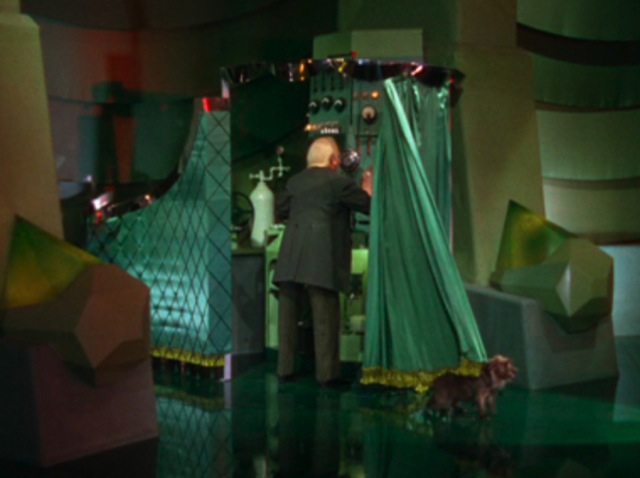
Pay No Attention to the Man Behind the Curtain

Master teacher and author Donna Farhi wrote in her book, “Bringing Yoga to Life: The Everyday Practice of Enlightened Living”:
One of the most devastating consequences of skewed perception is the longing that grows in us for someone to see us as we really are. We long to have someone, somewhere, even for a moment, really see us. When someone sees the “us” that is our essence, we say that we feel loved. My teacher taught that the primary thing to learn is how to be this loving, accepting presence. . . . When this longing to be seen by another is great, we become susceptible to chronic manipulation of our image. We may continually rearrange and reinvent ourselves in the hope that this new rendition will please our audience. Instead of being present, we perform. (pp. 179–80)

The Poet David Whyte says, “To be constantly explaining who you are is a gospel of despair.” He further invites us to simply be ourselves and in so doing give permission to all around us to do likewise.

In yoga, we practice self-witnessing as we breathe, move through poses, and meditate. Without this self-witness you can’t see you. No amount of others seeing or perceiving you will supplement for a lack of knowing yourself. It’s the paradox of rock stars feeling so lonely. Like a friend told me recently, it’s as if in our quest to experience and really discover/remember who we are, we feel like being seen by others is synonymous to being. There must be something there to see, right? But being witnessed isn’t witnessing. Yoga philosophy suggests that who we are fundamentally is the ability to truly witness ourselves.

Thanks, Mr. Oblique Yoga Philosophy Guy. That’s some awesome yoga thought but give me some real-life ways to relate that to getting up in the morning and facing another day of work and family and the every-day. Well, the easiest way to apply this is to just pay attention to your life. What does it feel like to sit in a warm shower and let the water flow over your skin? What do the blossoms smell like when you walk down the sidewalk? What does your breakfast taste like? What does it feel like when your boss walks by? Yoga practice is simply a condensed and refined way of paying close attention. Besides yoga makes us feel great, helps us have a healthy body, calm mind, and open heart. Here’s the deal: once we start practicing this self-witnessing business in yoga, we won’t stop at Namaste. We’ll be feeling our hamstrings in practice one night, and wake up extremely aware of the way the shower feels or maybe start to see the deep feelings in your heart. These are the most real ways of just being. The deeper we pay attention, the more we notice what’s behind the surface, what’s animating the outer form, what’s sensing, what’s seeing. Eventually, with practice, we become more and more familiar with this Inner Self. What’s amazing is how this knowledge of Inner Self gives us amazing confidence to just be. We stop trying to produce the image of ourselves, and we just be ourselves.

It reminds me of tales of Mark Twain giving lectures back in the day. He would walk out on stage in front of a packed theater and just stand there looking at the audience. The crowd would applause, would eventually quiet down and wait silently for him to talk. Instead of saying anything, he would just stand there and stare back to them, like he was staring down the whole place. The tension in the room began to build second by second as he just stood there looking back at them all. One man looking at thousands. He didn’t have to perform. He didn’t have to say anything. He was Mark-Freekin’-Twain! Finally, when the tension became almost unbearable, he could say one word and have the entire audience in his hands because he was completely real.

Writers, poets, yogis all have this one crucial thing in common: they all pay very close attention themselves and the world around them.
I’ll see you in class and we’ll practice some of this self-witnessing. Maybe this is what John Lennon meant by “let it be.”

Sunday, April 8, 2012

Change Rooms in Your Mind for a Day


Change Rooms in Your Mind for a Day
—Hafiz

I climb out of the car after 6 hours of freeway driving, fun holiday-weekend traveling and an amazing change of scenery, and jump into a different landscape, a dark, cool, spring evening. Summed up: short sleeves, short shorts, short run. The fragrant spring blossoms! I climb the hill to 13th and run by past East High with The Chili Peppers and Higher Ground rocking loudly in my ears; Adele, past the fire station; Marven’s Garden’s Is She Comin’ My Way, a band that has been very influential to me, as round the corner and back to my house; a little GnR as I climb my steps. Home. Maybe some Life cereal, write this bit, and then some sleep and things will feel different. They already do.

When shit goes down, and you don’t know where to go and what to do with whatever is troubling you, try simply changing your environment for a little while. This is what came to me on my run. One of my dear teachers, Jaisri, would tell me to just go walk outside, to connect with nature which is regulated by the principle of harmony. I guess that’s what Wallace Stevens meant when he said, “Sometimes the truth depends upon a walk around the lake.”

I guess that’s what I’m thinking about: Truth. Or at least truth as translated into what I believe at that moment. Because I think, and I’m sure you’d maybe agree with me here, that sometimes what we believe is true and what is True with a capitol T isn’t always the same thing. That’s because beliefs are constantly changing. For example, I used to believe that if I ate watermelon seeds, I’d grow a watermelon in my belly. Sure, I was 4 years old but that belief changed. I don’t worry about watermelon belly anymore but I still worry. Some things that I believe are true are True and others aren’t. The important thing, I think, is to understand there is a difference.

Yoga philosophy teaches us that our beliefs are a part of us but are changeable and therefore not the best representation of our True Self. Beliefs are just beliefs. Once we place our awareness above our perceived beliefs, and this includes worries, then we raise our consciousness to see something broader. We then escape the trap of thinking that things have to be all black and white, this way or that, right or wrong. We can see past our own rigid ideology (a schema of beliefs) and in so doing invite others to do the same. I believe this rise above ideology, to a paradoxical place where both sets of beliefs can be right, or to a place that is ultimately more important if either is right, is what harmony really means.

As I write, at this very moment, I’m looking next to me at the Zen painting hanging on my wall that I bought in Korea, where a monk with his giant calligraphy brush painted the symbol for harmony. I think I really understand this painting for the first time.

To raise our consciousness like this, to exit our old beliefs, the engines that make us worry, means we need to take a vacation from our own mind, from the way we’ve been previously thinking. Not that we have to change very radically. Just see a different something different. Like Hafiz says, we’ve gotta change rooms in our minds for a day. When you don’t know where to go, change your environment. Go on a walk. Get into nature. Jump into a yoga class and get out of those worry landscapes, those fear landscapes, and connect, even in a small way, with that part of you that is Harmony, that is the rue part of yourself.

One of my dear family members, a German scholar, loves to quote a Prussian general speaking to another general as he looks over a devastated battle field, “the situation is hopeless but not serious.” Thanks, Alan.

Scott

Here are a few poems I love that I feel relate to this topic

The Peace of Wild Things
When despair for the world grows in me
and I wake in the night at the least sound
in fear of what my life and my children's lives may be,
I go and lie down where the wood drake
rests in his beauty on the water, and the great heron feeds.
I come into the peace of wild things
who do not tax their lives with forethought
of grief. I come into the presence of still water.
And I feel above me the day-blind stars
waiting with their light. For a time
I rest in the grace of the world, and am free.
— Wendell Berry

All The Hemispheres

Leave the familiar for a while.
Let your senses and bodies stretch out

Like a welcomed season
Onto the meadows and shores and hills.

Open up to the Roof.
Make a new water-mark on your excitement
And love.

Like a blooming night flower,
Bestow your vital fragrance of happiness
And giving
Upon our intimate assembly.

Change rooms in your mind for a day.

All the hemispheres in existence
Lie beside an equator
In your heart.

Greet Yourself
In your thousand other forms
As you mount the hidden tide and travel
Back home.

All the hemispheres in heaven
Are sitting around a fire
Chatting

While stitching themselves together
Into the Great Circle inside of
You.

— Hafiz

Monday, April 2, 2012

Homeward Flight

You do not have to be good.
You do not have to walk on your knees
For a hundred miles through the desert, repenting.
You only have to let the soft animal of your body
love what it loves.
Tell me about despair, yours, and I will tell you mine.
Meanwhile the world goes on.
Meanwhile the sun and the clear pebbles of the rain
are moving across the landscapes,
over the prairies and the deep trees,
the mountains and the rivers.
Meanwhile the wild geese, high in the clean blue air,
are heading home again.
Whoever you are, no matter how lonely,
the world offers itself to your imagination,
calls to you like the wild geese, harsh and exciting --
over and over announcing your place
in the family of things.

Wild Geese by Mary Oliver

For me this poem says that is enough to just be. That we aren’t human doings, but human beings. That even grief is part of the human landscape and that no matter your circumstances, you belong to this amazing world which is constantly assuring us that we belong in a spirit of abiding contentment. You don’t have to prove yourself. You already are.

In yoga we practice being more than doing. The movement and the postures simply arrest our attention and show us the being part of human being. Practice with me this week as we all find our place in the family of things. Somehow this practice, just like the wild geese, is the journey back home.

Sunday, March 25, 2012

Understanding Coltrane

I love jazz. I love Jazz because it is a language. It speaks to a culture, a sophisticated musical discipline, and a style. For the longest time, I wanted to like jazz music but didn’t. Not much of it, anyway. I liked Kenny G. The first time I heard John Coltrane, all I heard was chaotic lines of complex notes hurled out the tail end of a tenor saxophone. But now, when I hear John Coltrane, I can’t keep up a conversation with anyone else because of the conversation I’m having with the music. So, what’s changed?

In part, I believe it was because I started to learn to play the sax. I’d always wanted to play the sax. When I was a kid, my dad asked his uncle Lester, a professional sax player, what it would take to help me appreciate playing the sax. Lester told him to start me on the piano, move to the clarinet, and then to the sax. That way I would have the rudiments of music woodwind instruments to spring me forward as I started to play the sax. I never really met Lester. There exists a sun-bleached photo of me and my entire family posing for the camera on his back porch but this was before dawn of my consciousness—I was about three and don’t remember it at all. Well, Lester died. And nobody remembers exactly how, nobody remembers doing it, but somehow his horns showed up on my doorstep with my name on them. I was 13. I’d been playing the clarinet for 2 years and I was itching to start the sax. Problem was, I didn’t have one. Not until that day when Lester’s horns, (yep, he gave me not one but TWO saxophones, an alto and a tenor AND a clarinet) showed up thanks to a mystery and the US postal service. I scarcely remember a more exciting or more reverent day of my life than when I received those horns. They are the saxes I still play today. That day, I remember feeling like something very important had just happened to my life.

That summer, I started to blow through the horns and figured out how to finger the notes and make a decent sound before any teacher got to me. Lester was right and the clarinet and piano had paid off. As I continued to learn to play the sax, I began to learn to play jazz. And with just a little bit of experience of trying to play jazz, I began to appreciate listening to jazz. Not long after that, I loved it. With a little experience of jazz, the music meant something to me; I could understand the sounds I heard as emotions and experiences. I can hear intervals between notes, feel chord changes come and go and understand and appreciate the inherent tension and release of jazz. More than that heady stuff though, I can sit back and feel the groove and swing of it, I can feel the flavor and texture of it. I can appreciate the personalities behind the music. For me, when you’re invited to see the bigger picture, I can savor the individual parts better

This is often what happens when we begin to understand and appreciate the underlying form of almost anything be it jazz or yoga. A yoga asana is beautiful on the outside but understanding the underlying form—the mechanics of muscles, bones and even subtleties like energy and intention—makes the posture understandable, enjoyable and enlightening. Yoga is about understanding oneself deeper. Any deeper look inward, even just at anatomy, fulfills the ends of yoga.
The underlying form expresses itself clearly in the outerlying form in our yoga postures: slumped shoulders might manifest for the depressed or burdened or shy, broad shoulders for the confident, open hearted, and gregarious. As a teacher, I can’t read your mind, can’t feel your soul, but I can see how your consciousness produces the product of a very engaged outer form. So in that sense, I often know whether your mind is present by how your poses look. The outerlying form reflects the under.

Of course the underlying and outer lying forms are inseparable. You can’t have the pose without the energy or thought or emotion behind it, you can’t have jazz without its history and culture, you can’t have the blues, without feeling blue. So really what this means is to learn to see the whole picture is attuning our senses to the specifics and intricacies of a sophistication of seeing all the parts. We engage on a deeper level. It makes the practice of jazz or yoga so rich. By understanding the underlying form, we might acquire a taste for more complex things like deeper poses, meditation, Coltrane or dark chocolate. And soon we might begin to understand a little about the underlying form of all things and learn to see that with increased flavor and appreciation.

So maybe, years later, because I’ve learned a little about the underlying form of jazz, for my buck I’d choose John Coltrane over Kenny G, though I still understand Kenny G’s technical proficiency and his beautifully clear and distinct sound. Come to practice this week and let’s focus on understanding ourselves by looking at underlying form both in practical, anatomical ways as well as conscious, meditative ways.

Until then, if you’re interested click here to hear John Coltrane play Blue Trane, in my opinion one of the best sax solos in all of jazz.

Sunday, March 18, 2012

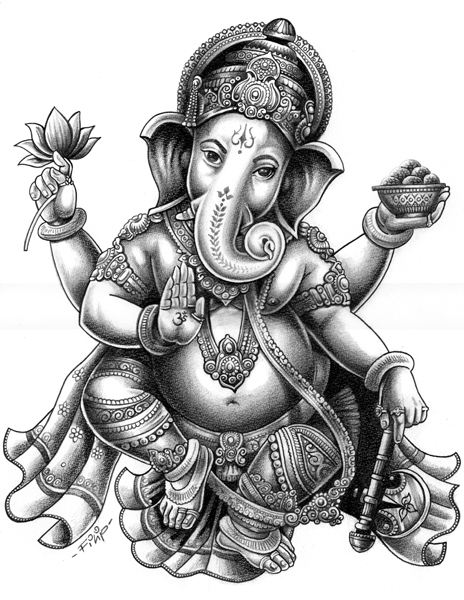
Ganesh: Guardian of the Temple


Om Gam Ganapataye Namah

This is the chant to Ganesh, the mythical figure in Hindu iconography who represents the remover of obstacles, the gatekeeper between the earthly world and the spiritual world.
Here is one version of his story.

According the Hindu mythos, Siva and Shakti represent the primordial male and female entities of the universe, the creator and mother of the universe. They are represented by the familiar eastern symbol, the yin and yang. In this symbol, the dark side represents the female aspect of the universe (not necessarily gender), embodiment, cool, dark, and movement. The light side represents the male aspect, energy, spirit, warmth, and awareness.

Early in the history of this myth, Siva was often away from Shakti as he attended to the responsibilities of ruling the universe. As happens with all newlyweds, eventually the honeymoon period seemed to be over between the two of them. Often, Siva would return home from his responsibilities of creating the universe and without much sensitivity, he felt entitled to Shakti's bed chamber. Shiva only craved the physical and Shakti craved the spirit.

Once again when Siva left, Shakti mourned the lack of intimacy that they once shared. So, from her laughter, Shakti created a son and named him Ganesh. As the son of embodied movement, Ganesh was an amazing physical creature. In addition to giving Shakti companionship and love, Shakti gave Ganesh the charge of guarding the gates to her bedroom; under no circumstances was he to allow anyone to pass.

As you may imagine, when Siva returned home, as per his habit, he marched straight toward Shakti's bed chamber and was met abruptly by this new creature, Ganesh. "None shall pass," said Ganesh (I'm thinking of Monty Python, here). Annoyed, Siva sent some of the members of his posse to go and take care of this little boy blocking the way. As the son of Shakti, Ganesh proved to be a powerful creature and probably looked like the young Vin Diesel of Hindu Gods as he cleaned house with Siva's brute force. As Ganesh was more than holding his own against his attackers, Siva started to get a little nervous. He thought, "This won't look good if this little kid takes care of my posse. Even worse if he then schools me," Siva thought. So while Ganesh wasn't looking Siva threw his trident and beheaded Ganesh.

Hearing all the commotion, Shakti came out of her room and saw her now dead son on the floor. She threw the stink-eye at Siva as if to say, "Fix this. NOW." Siva, seeing that he was in hot water, told his right hand man to go and find him a head. Any head. He returned with a head-an elephant head. Siva said, "This will have to do." And with that, brought Ganesh back to life. This story taught Siva that even he needs to earn entrance into the gates of the sacred chamber, into the temple.

The symbol of Ganesh helps to remind us of several aspects of our yoga practice as well as our practice of daily living. Many of the depictions of Ganesh show him sitting with one of his legs in the enlightened pose of lotus while his other foot rests comfortably on the ground. This teaches that while we are seeking spiritual progression, we must also keep our contact with the physical world. Even more than that, it shows that the path to spiritual expression is often through the magic and joy of the physical form. Our yoga practice is the perfect example: we move our bodies as a tool which points to the spirit. Every time I see someone roll down the road on their skateboard, I think of that soul experiencing a touch of enlightenment through the bliss of motion through time and space. Whether skating or performing asana, we allow ourselves the indulgence of the underlying form of mind and heart through the physical machinations of the body. Through the body, we give ourselves a tangible connection to spirit.

The gateway to the body is the connection between ground and body: the pelvis and hips. This week, let's entice the sentinel, Ganesh, as we break off the rust of the gates to the temple of heart and mind and open our hips, stretch the legs, external rotators (outside of the buttocks) and the hip flexors (groins). We'll not only learn the steps to enter the gates toward the sacred chamber of heart and mind through the body, but also make the practice sweet and allow the entire journey to be a joy. My intention is to learn a little about the ancient myths of yoga while giving freedom and joy in our hips. We'll float out of class.

Sunday, March 4, 2012

On Busyness


Are you busy? I’m busy. It seems like we’re all busy. And when your schedule is busy your mind is busy processing and planning and negotiating it all to make sure it gets done. And that is precisely the trapping of busyness: you get so harried, so scattered, that you can’t really focus on anything very well. Your nervous system gets shorted out, your energy reserves get depleted, and you never have enough time and you end up increasingly more and more tired.

I don’t think we’re alone. In fact, around 200 AD the yoga scholar Patanjali wrote an entire freegin’ yoga sutra on the topic. It’s the primary source for all the philosophy most of us yogis study. Right at the beginning of this ancient text he states very clearly that the entire purpose for doing yoga is to stop the mind from all its busyness. And that was 1800 years ago before kids’ soccer practice, the 9-5, and the 27 other things we have going on during any regular weekday night.

Easier said than done, right? It’s like when I get worked up about something, am really upset, and someone comes up to me and gratuitously offers that smidgen of infallible advice, “hey, chill out.” Rarely, has advice ever found purchase with me. I imagine myself stopping mid-freakout, relaxing all my tension, and just as that stupid smile of contented relief begins to spread across my face, I say, “Thanks! Why didn’t I think of that?” No! I need to work through it. The same goes with busyness. It doesn’t work to simply say, stop being so busy all the time. There needs to be a processing, an accounting for the busyness and then maybe we can find some practical and lasting method of stopping the madness.

After a while of running around with your head cut off, if you’re like me, you’ll take a moment from the craziness and ask if there is a better way of being. Ironically, part of the processes of reducing busyness is getting completely exhausted, completely fed up with busyness, to realize it’s not you and to begin the mindful process of escaping the madness. Maybe, if you’re like me, you could take a good honest look at why you make your schedule so busy. Maybe another question to ask is, “What are those things in life that mean the most to me?” and begin to organize your time and energy toward that stuff first.

I suppose this is what yoga does for us. Yoga gives us the opportunity for a pause, for reflection, and for focus. It is one of the most practical ways I know of learning to practice being in a place where everything is simplified down to that which makes the most sense, body and breath. Maybe with this simplified perspective, we can take a look at those things on our schedule that don’t really serve us and commit to spend some time, meditating, doing some yoga, or catching up on Anne of Green Gables. But what about all the stuff we gotta do for our kids, taking them to this practice, this playdate, this kids’ activities? With a little mindfulness and creativity, you’ll find a solution for that too. After all, what are we teaching them with all of our busyness?

If coming to yoga class is going to be one more thing that busies your schedule, I might suggest take the pressure off of yourself and stay home. Seriously. If you can arrange to come and not have it be “one more thing” to add to an already busy schedule, then I’d love t see you in class this week as we focus together and practice some radical simplification. Maybe we’ll gain some clarity on those things on our schedule that don’t serve us and could be replaced by something that does.
See you in class, OR NOT.

Sunday, February 26, 2012

Why Is That Guy Standing on a Baby?


My friend Rachel came to class to Prana Yoga around Thanksgiving time and brought 9-10 of her visiting siblings and/or their spouses. I thought it was really cool to have such a huge family together practicing yoga. Rachel’s comes from healthy and active stock, everyone seemed very athletic and capable, even though there were a few of them who were new to yoga. I welcomed everyone to class asked the class if they had requests or injuries I could be careful with. One of Rachel’s family member’s, one who was relatively new to yoga, raised his hand and asked, pointing to the 4.5 ft. statue behind me, “Why is that guy standing on a baby?” What a fantastic question! And suddenly I began to wonder how many people walk in and out of our studio each day and see this imposing statue of Siva with his many arms, surrounded by a wreath of fire, a snake around his belly, dancing dreadlocks, standing on an impish creature and wonder what is going on with that cat.

Yoga synthesizes ancient wisdom with our modern circumstances to provide a practice for being in the world and for understanding ourselves. Plus, it just feels good. Yoga’s many ancient symbols and philosophical tenants can seem not only confusing to modern, western practitioners, but also down right alienating. I’m always asking the question, “So what? What does all this ancient wisdom and symbolic gobbildy gook have to do with waking up each morning, dragging my butt outta bed, and going out into the world to live another day?” Well, let’s see.

So, the Dancing Siva, or Siva Nataraj (meaning royal dancer), is a statue that tells many stories. To understand the mystery of the squashed baby, maybe we could look at several of the symbols in this statue. First, it represents an idea of the creator of the Universe who propels the continuous dance of all things. Shiva’s limbs illustrate this cosmic dance of birth, life, death, and rebirth.

In his first hand, Shiva’s holding a drum, laying down the beat, the vibration that quickens everything in the universe. Modern science says that everything is vibration, frequency, from the smallest particle to the largest galaxy. As a musician, I like that idea of the universe being created by DJ Shiva laying down a steady backbeat that makes everything in the universe pulse.

Next Shiva is holding out his hand, fingers up, palm out, in the Abhaya mudra. A mudra is a symbolic and energetic hand gesture. This mudra represents sustaining. Shiva’s saying, “Hey, man. I got you.” Things were created and then are sustained or stay in motion.

Shiva’s third hand and holds a flame. It says not to get too attached because everything changes. Things wilt, fade, and die. Physics 101: energy and matter cannot be created or destroyed, rather it simply takes on a different form: leaves fall, become mulch, soil, nutrients, reabsorbed , become another leaf, etc. This might be a practical understanding of reincarnation. Let’s not get into that here. What I’m getting at is that Shiva is suggesting that change is the program.

Shiva’s fourth arm crosses his chest concealing his heart. He’s telling us that you don’t get a free ride to know the heart of God, or your own deep divinity. To know this heart you have to work to see it. And translate “God” however you want, the divine part of yourself, a supreme being, you choose. Either way, you can’t be a wall flower in this cosmic dance of existence. To really appreciate the fact that everything is moving you gotta to join the dance, gotta shake your booty, gotta be willing to scuff your shoes and sweat. But hey, the dance enthralls us.

Ok. This still doesn’t explain why Shiva is doing Riverdance on this poor creature’s back. So, with one leg, Shiva is standing on a creature known as Apasmara. It looks like a baby, sometimes a demon, sometimes pig-like, and while this seems a little callous of Shiva, this action is actually quite compassionate. That’s because this Apasmara isn’t a baby but a creature that represents our own ignorance. He knows our divine potential and won’t stand for anything less. So, while one leg stands on this demon-thing, his other leg is lifting in a gesture that invites us to rise from that old, ignorant self into a new understanding of ourselves. He’s revealing our true nature and with that perspective also revealing to us a new relationship with our old circumstances. He is the dance partner inviting us to rejoin the dance of our life, with new understanding, through the continuous dance of birth, sustaining, death, and rebirth. He’s telling us to constantly reinvent our relationships, our jobs, and our passions.

And THAT is why Shiva is standing on that thing that looks like a baby. My hope is at very least we understand this symbol a little better. Maybe this week when we are practicing yoga at Prana under Shiva’s calm gaze, in all his dynamic magnificence, we might remember some of the reasons we practice yoga. Maybe we can use the symbol of Shiva standing on Apasmara to allow this transforming practice of yoga to give us the strength, hope, and clarity, to take action in our lives and commit to reinvent it over and over again in this wild dance of our own existence.